Choosing an Aluminium Washroom Door is not merely a matter of matching a finish to a floor plan. These doors face repeated cleaning, damp air, frequent use, and occasional impact from bags or carts. A good supplier should explain how its frames, hinges, locks, and panels perform together—not just show a polished catalogue image.
Architect Louis Sullivan’s well-known principle, “Form ever follows function,” offers a useful lens for comparing suppliers. For washrooms, function means dependable privacy, smooth operation, and materials suited to the site’s conditions. The details matter. Check door thickness, edge construction, hardware options, installation support, and the stated warranty. Ask how finishes hold up around wet floors and strong cleaning products. A sample in your hand can reveal more than a render.
This guide presents ten worldwide suppliers and considers their product ranges, manufacturing capabilities, customization, and service. It is a starting point, not a universal ranking. Availability, lead times, certifications, and after-sales support can vary by region and project, so confirm current details directly with each company. A supplier may look strong on paper and still be a poor fit for one building. That happens.
Look closely. Ask specific questions. Compare like with like. The best choice is usually the one that can document its claims and respond clearly when specifications change. Even then, no shortlist replaces a project-specific review of measurements, hardware, and installation conditions.
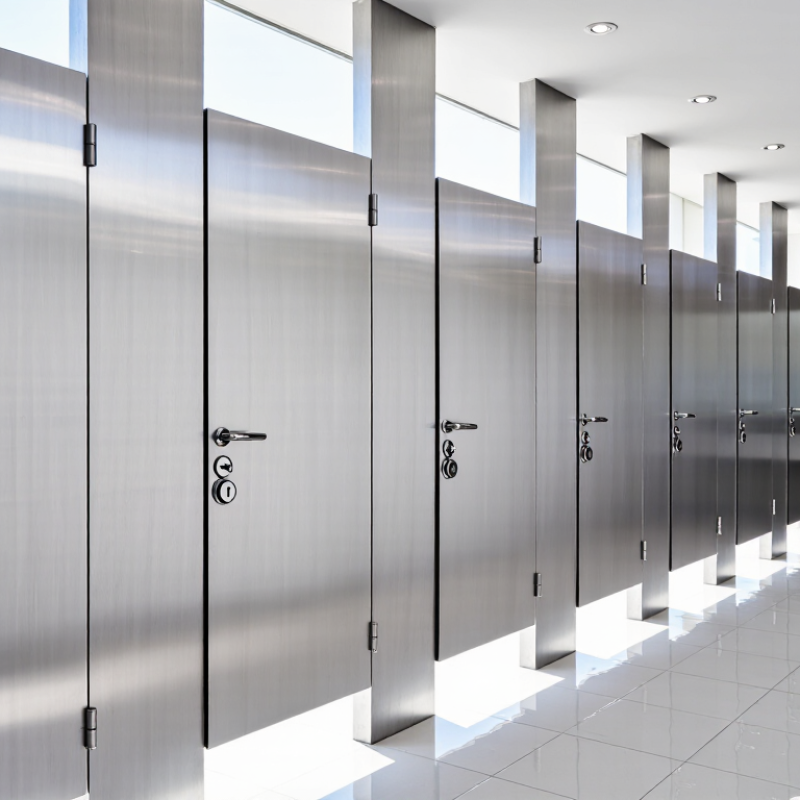
Aluminium washroom doors are lightweight doors made with aluminium frames, panels, or both. They are designed for areas exposed to humidity, frequent cleaning, and heavy daily use. Unlike untreated steel, aluminium does not easily rust when its protective finish remains intact. It resists moisture well.
These doors suit public toilets, offices, schools, hospitals, hotels, and transport facilities. Their low weight reduces stress on hinges and frames. A powder-coated or anodized surface can provide color stability and easier cleaning. Door leaves may include ventilation gaps, privacy locks, concealed hinges, and impact-resistant infill panels.
Proper ventilation still matters. No door can solve persistent condensation alone.
During supplier evaluation, check alloy thickness, panel construction, edge protection, hardware quality, and test documentation. A reliable supplier should explain cleaning methods, replacement parts, lead times, and installation tolerances.
Site measurements must include wall levels, opening direction, floor clearance, and cubicle spacing. Small errors become obvious after installation. A perfect specification rarely exists, especially in older buildings with uneven walls.
Some low-cost doors look attractive but use weak cores or thin hardware. That weakness appears quickly in busy washrooms. Samples, drawings, and written performance details provide stronger evidence than photographs.
Procurement teams should also confirm whether the finish may discolor under harsh chemicals. This point is sometimes overlooked.
Evaluating global aluminium washroom door suppliers requires more than comparing catalogue prices. Start with alloy grade, wall thickness, and surface treatment. Ask for test reports, not marketing claims. Doors in humid washrooms need verified resistance to corrosion, staining, and repeated cleaning. Hardware should survive frequent opening, impact, and moisture exposure. A practical test includes hinge alignment, latch operation, and panel deflection after repeated cycles.
Material transparency also matters. The International Aluminium Institute reports that recycling aluminium can save about 95% of the energy required for primary production. Therefore, request recycled-content data, supply-chain evidence, and an ISO 14025-compliant Environmental Product Declaration where available. UNEP’s 2022 Global Status Report states that buildings and construction consume 34% of global energy and produce about 37% of energy-related emissions. Supplier selection should consider the complete door system, including frames, fittings, packaging, and replacement parts.
Production reliability deserves equal attention. Review factory capacity, quality-control records, export experience, lead times, and documented installation guidance. Request samples with real corner joints and finish details. A beautiful sample can hide weak internal construction. Warranty length is useful, but response procedures matter more. Ask who handles failures and how quickly spare hardware ships. Independent certifications help, yet certificates may not cover the complete assembly. This is where evaluation becomes imperfect: regional test methods differ, and site conditions are rarely identical. Reference projects, batch inspection, and clear technical drawings reduce that uncertainty.
These profiles reflect practical purchasing factors, not advertising claims. The International Aluminium Institute reported global primary aluminium production above 70 million tonnes in 2023, showing the material’s industrial scale. Its recycling data also supports aluminium’s long service potential, although recycling performance depends on collection and separation systems. That detail is easy to overlook.
The strongest suppliers usually publish alloy grades, coating specifications, hardware test results, and installation tolerances. Buyers should check water exposure, ventilation, cleaning chemicals, and expected traffic before comparing prices. Industry market studies, including reports from Grand View Research and Mordor Intelligence, identify construction and renovation as important demand areas for aluminium products. However, forecast figures vary considerably between reports. That uncertainty matters. A reliable supplier should provide sample sections, warranty terms, replacement-part availability, and documented compliance with applicable building standards. Door alignment still depends on site workmanship. Even an excellent profile can fail when measurements are rushed.
When comparing the top 10 aluminium washroom door suppliers worldwide, look beyond catalogue size. Check whether each offers hinged and sliding doors, slim or heavy-duty frames, privacy indicators, and matching partitions. A broad range helps with mixed-use projects, but only if replacement hardware remains available. Ask for drawings showing frame depth, panel thickness, and clear opening width. Small details matter.
Customization should be measurable, not just promised. Request finish samples, non-standard dimensions, accessible-threshold options, and hardware schedules before approving a specification. The International Aluminium Institute reports that recycling aluminium uses about 95% less energy than producing primary aluminium. This supports asking suppliers about recycled content and documented material traceability. It does not prove that a finished door is low-impact; request project-specific evidence. Some claims remain vague.
Certifications also need careful comparison. ISO 9001 concerns quality management, while ISO 14001 addresses environmental management; neither alone certifies a door’s durability or moisture resistance. Ask for applicable test reports covering corrosion, hardware cycles, and finish performance, with the tested configuration clearly identified. Verify certificates with the issuing body and check their scope and expiry date. A polished brochure is not a test report.
Selecting a suitable aluminium washroom door supplier requires more than comparing catalogue prices. Examine extrusion quality, panel thickness, hardware grades, fire performance, and installation support. A credible supplier should provide batch records, test certificates, dimensional drawings, and clear warranty terms.
The International Aluminium Institute reports that recycled aluminium requires roughly 5% of the energy used for primary aluminium production. Ask suppliers to disclose recycled content and provide traceable material certificates. This supports sustainability claims without accepting vague marketing language. Check production capacity through recent project evidence, not promises. Request a sample door and inspect its edges, hinges, powder coating, and lock alignment. Small defects become expensive across hundreds of cubicles.
Supplier audits should include quality controls, worker safety, packaging methods, and replacement procedures. ISO 9001 certification is useful, but it does not guarantee perfect products. I have seen paperwork look stronger than actual workmanship. An independent inspection before shipment can reduce that risk. The 2023 World Bank Logistics Performance Index also shows why delivery planning matters; customs, tracking, and transport reliability vary widely between markets. Compare lead times using the same quantities and specifications. Confirm whether prices include tooling, protective film, spare hardware, export packaging, and installation guidance. Get everything in writing. A low quotation may simply hide missing services. Keep two qualified suppliers when project schedules cannot tolerate one factory’s delay.
They are lightweight doors made with aluminium frames, panels, or both. They suit humid, frequently cleaned spaces.
They fit public toilets, offices, schools, hospitals, hotels, and transport facilities. Busy washrooms benefit from their lower weight.
Aluminium resists moisture and does not easily rust when its protective finish remains intact. Damage to that finish still needs attention.
Useful features include ventilation gaps, privacy locks, concealed hinges, and impact-resistant infill panels. Proper room ventilation remains necessary.
Check alloy grade, wall thickness, panel construction, edge protection, and hardware quality. Ask for test reports, samples, and technical drawings.
Samples reveal corner joints, surface finishes, and internal construction more clearly than photographs. A polished sample can still hide weak materials.
Measure wall levels, opening direction, floor clearance, and cubicle spacing. Small errors matter. Uneven older walls may complicate installation.
Review production capacity, quality records, lead times, export experience, and replacement-part support. Warranty length helps, but response speed matters more.
Recycled aluminium can use about 95% less energy than primary aluminium. Request recycled-content evidence and assess packaging, fittings, and replacement parts.
Thin hardware, weak cores, poor hinge alignment, and chemical discoloration may appear quickly. Some problems are easy to overlook.
This guide explores the role of the Aluminium Washroom Door in modern commercial, institutional, healthcare, hospitality, and public facilities. It explains how aluminium doors provide a practical balance of durability, moisture resistance, low maintenance, hygiene, and design flexibility. The article also highlights key features such as corrosion-resistant frames, reliable hardware, privacy-focused construction, fire and safety considerations, and options for different layouts and traffic levels.
It then presents ten leading types of global suppliers without focusing on brand names, evaluating them according to manufacturing experience, product quality, customization capacity, delivery capability, technical support, and relevant certifications. A clear comparison of product ranges, finishes, dimensions, accessories, and tailored solutions helps buyers identify suitable options. Finally, the guide offers practical advice on selecting and sourcing a supplier, including checking specifications, requesting samples, confirming compliance, reviewing warranties, comparing total costs, and establishing clear communication before placing an order.

Apex Window & Door