Choosing an Aluminum Door is not just a matter of matching a color to a façade. It can affect daylight, privacy, comfort, and how smoothly a busy entrance works. The right choice depends on the opening, local weather, daily traffic, and the building’s style. Yet glossy product photos rarely reveal how a frame feels, how a threshold handles rain, or whether a finish suits the surrounding materials. Looks can mislead.
A practical decision starts with accurate measurements and a clear idea of how the doorway will be used. Check frame construction, glazing options, thermal performance, drainage details, and the manufacturer’s product specifications. Ask how the finish is maintained and what the warranty covers; vague answers deserve a closer look. Hardware matters, too. A handle that feels sturdy in a showroom should still operate comfortably for everyone who uses the entrance. Installation matters. Even a well-made door may perform poorly if it is fitted out of square or sealed carelessly, so confirm who will handle the work and what preparation is required. There is no single best design for every home or project, and some attractive options may exceed the available budget. This guide explores ten useful points to weigh before choosing, helping you compare appearance with everyday performance and spot details that deserve a second look.
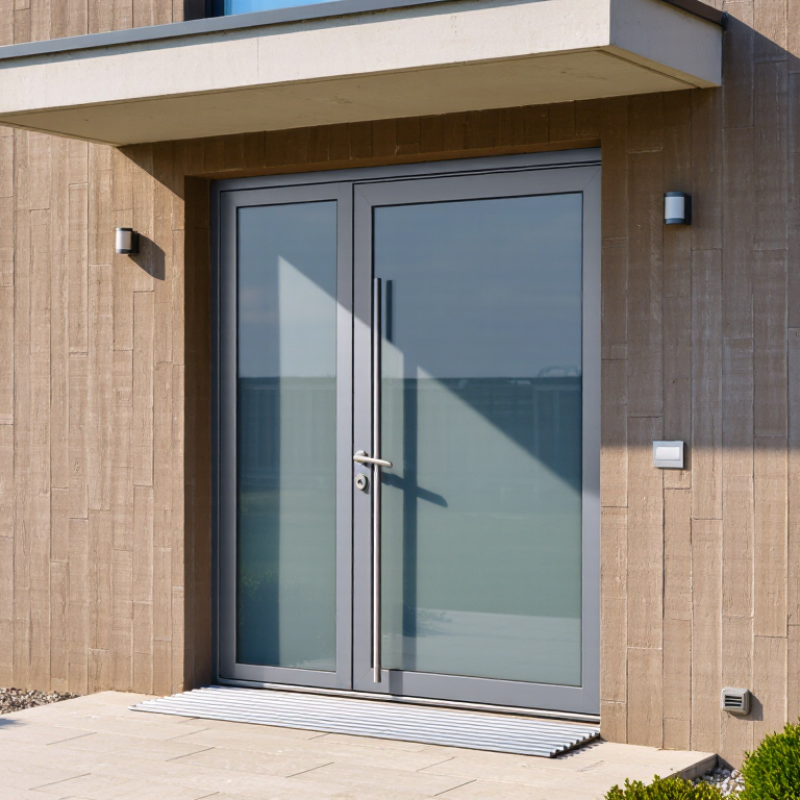
An aluminum door for a quiet bedroom faces different demands than one serving a busy hotel entrance. Define traffic, exposure, operating frequency, and security needs before comparing finishes or hardware. A coastal entrance may face wind-driven rain, salt air, and repeated impacts. A sheltered interior door may not need the same resistance.
The NAFS standard, AAMA/WDMA/CSA 101/I.S.2/A440, groups products into R, LC, CW, and AW performance classes. Residential doors generally suit R class applications. Light commercial projects may require LC, while commercial and architectural entrances often need CW or AW. Confirm the tested performance grade, not only the class. Design pressure, air leakage, water penetration, and structural loading all matter.
Numbers expose an easy mistake. The U.S. Department of Energy reports that windows can represent 25% to 30% of residential heating and cooling energy use. A poorly specified door can add similar comfort problems near the threshold. Look for documented test results and a compatible sill, seal, and installation method. The door alone cannot fix a weak opening.
Do not select AW simply because it sounds stronger. It may increase cost, weight, and hardware demands without improving the actual project. Review local wind maps, building height, occupancy, and exposure with a qualified fenestration professional. Small omissions become obvious during the first storm.
When choosing an aluminum door, compare the whole-unit NFRC ratings, not just the glass. U-factor measures heat transfer; lower numbers generally mean better insulation. SHGC measures how much solar heat passes indoors on a scale from 0 to 1. A rating of 0.25 admits less solar heat than 0.60. Small numbers matter.
Tip: Match SHGC to the door’s direction and climate. A lower rating can reduce afternoon heat through a sunny west-facing door. A higher rating may allow more winter sunlight indoors. Check U-factor too, especially if the door opens onto a cold, drafty entryway. Aluminum frames can conduct heat, so look for a thermal break and confirm the rating covers the complete door.
The U.S. Department of Energy’s Energy Saver guidance estimates that heat gain and loss through windows account for 25%–30% of residential heating and cooling energy use. That figure covers windows broadly, not every aluminum door, but it shows why ratings deserve attention. NFRC labels make product comparisons more consistent. Still, ratings do not describe every detail: installation gaps, weatherstripping, and exposure can change real-world performance. I’d treat the label as a useful starting point, not a promise of comfort.
Aluminum’s density is about 2.70 g/cm³, according to the Royal Society of Chemistry’s periodic table. That number matters. It helps explain why aluminum frames can be relatively light, but it does not prove a frame is strong or durable. Alloy, temper, wall thickness, corner joints, and hardware all affect performance. A common buying mistake is comparing only the visible frame width. Ask for the alloy and temper, then check whether the frame’s design data reflects the actual profile. The Aluminum Association’s Aluminum Design Manual provides engineering values for aluminum alloys and tempers; those details are more useful than a density figure alone.
Thermal breaks deserve equal scrutiny. A continuous aluminum frame conducts heat readily; an insulating strip between its inner and outer sections interrupts that path. Look closely at a sample corner: the separator should be continuous, firmly joined, and free of obvious gaps. Small detail, real impact. Request whole-window U-factor data, not just claims about the frame. NFRC 100 sets procedures for rating fenestration product U-factors, while ISO 10077-2 provides calculation methods for frame thermal transmittance. Ask which test or calculation supports the quoted value. It is easy to overfocus on the alloy number; the installed unit’s glazing, seals, and frame work together, and that part is sometimes overlooked.
| No. | What to Assess | Practical Check | Why It Matters |
|---|---|---|---|
| 1 | Frame alloy and temper | Ask for the alloy and temper designation in the product specification. Aluminum alloy 6063 is commonly used for architectural extrusions; confirm that the proposed profile is suitable for the door’s size and use. | Alloy and temper affect strength, formability, and suitability for different frame profiles. The alloy name alone does not establish the performance of a complete door. |
| 2 | Thermal break | For an exterior door in a climate where heating or cooling matters, check whether the frame separates its interior and exterior aluminum sections with a low-conductivity insulating barrier. | Aluminum conducts heat readily. A thermal break can reduce heat transfer through the frame compared with a similar non-thermally-broken frame. |
| 3 | Whole-door thermal performance | Request the tested or rated U-factor for the complete door configuration, including its frame and glazing. Compare products using the same rating method and units. | The whole-door value is more informative than a frame-only claim. A lower U-factor indicates less heat transfer under the applicable test or rating method. |
| 4 | Frame strength and door size | Confirm that the manufacturer’s structural information covers the door’s dimensions, panel weight, wind exposure, and expected use. Check that the specified profiles and reinforcements match the configuration. | Aluminum has a density of about 2.7 g/cm³, but density alone does not determine a door’s strength or weight. Profile design, alloy, temper, and construction also matter. |
| 5 | Glazing and glass specification | For glazed doors, verify the specified glass type, thickness, safety-glazing requirements, and compatibility with the door system and local building rules. | Glazing affects safety, energy performance, noise control, and the overall weight carried by the frame and hardware. |
| 6 | Weather seals and air leakage | Look for continuous, replaceable weatherstripping at the frame and meeting edges. Ask for air-leakage test results for the relevant door configuration where available. | Well-fitted seals help limit drafts and the passage of dust and moisture. Performance depends on the complete assembly and its installation. |
| 7 | Water management and drainage | Check how the sill and frame manage water, including drainage paths and weep openings where the design uses them. Make sure openings will not be blocked during installation. | Effective water management helps direct incidental moisture away from the building interior and can reduce the risk of water-related damage. |
| 8 | Finish and corrosion exposure | Specify the finish and color, and ask whether it is anodized or coated. For coastal or other corrosive environments, check that the finish and fasteners are suitable for the exposure. | Finish choice affects appearance and surface protection. Corrosion resistance depends on the finish, environment, maintenance, and contact with other materials. |
| 9 | Hardware and security | Check hinge capacity, locking points, handle operation, and compatibility with the door’s size and weight. Where security ratings are important, request documentation for the tested complete assembly. | Hardware must suit the door and its frequency of use. Security claims are most useful when tied to a recognized test or rating for the complete door system. |
| 10 | Installation, warranty, and maintenance | Confirm the required opening dimensions, anchoring method, perimeter sealing, adjustment procedure, warranty coverage, and care instructions before ordering. | Correct installation helps the door operate and seal as intended. Clear maintenance and warranty terms make long-term care and support easier. |
A door should match the building, not merely look attractive. Check its NAFS rating under AAMA/WDMA/CSA 101/I.S.2/A440-22. This standard evaluates air infiltration, water penetration, and structural performance. Ask for the complete test report, not only a marketing grade. Do not guess.
Air ratings show how much air passes through a closed, tested assembly. Lower leakage is generally better, especially near windy coastlines or high-rise façades.
The U.S. Department of Energy reports that windows and doors can account for 25–30% of residential heating and cooling energy use. That figure is not a direct door prediction, but it shows why uncontrolled leakage deserves attention. Compare the tested air rate with the project’s energy model and ventilation plan.
Water ratings require equal care. NAFS testing applies pressure differences, but real storms may combine wind, rain, debris, and poor drainage.
Structural ratings also need comparison with site-specific wind pressures, including height, exposure, corner zones, and door size.
ASCE 7-22 provides the wind-load procedures commonly used for design. A rating that passes in a laboratory may still be unsuitable after installation errors. Check sill pans, fasteners, joints, and surrounding wall construction. Recheck the assumptions.
When choosing an aluminum door, verify the safety glazing before comparing finishes or hardware. ANSI Z97.1 establishes impact-performance requirements for architectural glazing. It evaluates whether glass stays in place, cracks safely, or breaks into less hazardous fragments after impact. The U.S. Consumer Product Safety Commission’s National Electronic Injury Surveillance System identifies glass doors and windows as recurring sources of emergency-department-treated laceration injuries. The risk is not theoretical.
Ask for the glazing specification and the laboratory test report. Look for an ANSI Z97.1 reference, the applicable classification, test date, and traceable product identification. A permanent safety-glazing mark should also be visible on the glass or spacer. Do not accept a sales label alone. It may describe the door, not the glass.
Check exposed sidelites, narrow glass panels, and areas beside the latch. These locations are easy to overlook. Tempered and laminated glass can both qualify, but their breakage behavior differs. Laminated glass may remain attached after cracking; tempered glass usually fragments into small pieces. The right choice depends on location and impact exposure. Local building requirements may also apply.
In practice, paperwork is where mistakes appear. I have seen attractive door packages with incomplete glazing records. That is a warning sign. If the supplier cannot connect the marked glass to a credible test report, pause the order and request independent verification from a qualified glazing professional.
ANSI Z97.1 impact-test classifications commonly cited for safety glazing include Class A at a 48-inch drop height and Class B at an 18-inch drop height. Confirm the applicable standard edition, product marking, and requirements for your specific installation.
Use this comparison as a prompt to check glazing documentation—not as a substitute for verifying that a specific door assembly complies with applicable codes and project requirements.
Start with traffic, weather exposure, operating frequency, and security needs. A sheltered interior door faces different demands than a busy, rain-exposed entrance. Check the tested performance grade, not just the class. Small omissions show up in storms.
The classes are R, LC, CW, and AW, covering different residential and commercial applications. The right choice depends on the building and exposure. AW is not automatically better; it can add cost, weight, and hardware demands.
Ask for the alloy, temper, wall thickness, and frame design information. Density alone cannot prove strength or durability. Look beyond the visible frame width. That detail can be misleading.
It separates the frame’s inner and outer aluminum sections, reducing heat transfer. Inspect a sample corner for a continuous, firmly joined separator. Request whole-unit U-factor data, including the glazing and seals. The frame is only part of the picture.
Request the glazing specification and a traceable test report referencing ANSI Z97.1. Check for a permanent mark on the glass or spacer. A sales label alone may identify the door, not the glass.
Check sidelites, narrow glass panels, and areas beside the latch. These spots are easy to miss. Tempered glass usually breaks into small pieces; laminated glass may stay attached after cracking.
No. The glazing, seals, sill, frame, and installation all matter. A well-rated door can still perform poorly in a weak opening. I might still overlook the sill; it is worth checking twice.
Pause the order and ask the supplier to connect the marked glass with a credible test report. If the records remain unclear, seek independent review from a qualified glazing professional. Don’t guess.
Choosing the right Aluminum Door starts with understanding where and how it will be used. Select a NAFS performance class suited to the opening and its exposure, then compare NFRC U-factor and solar heat gain coefficient (SHGC) ratings to balance insulation and heat from sunlight. SHGC is measured on a scale from 0 to 1, with lower values generally allowing less solar heat to enter. Consider the frame alloy and whether it includes a thermal break; aluminum has a density of about 2.7 g/cm³, while a thermal break can help reduce heat transfer through the frame.
Before making a decision, check that the door’s NAFS air, water, and structural ratings match the site’s expected conditions and loads. Also verify that any safety glazing meets ANSI Z97.1 requirements. Reviewing these factors together can help you choose a durable, comfortable door that fits the building’s performance needs.

Apex Window & Door