Choosing the right Aluminum Bathroom Door requires more than matching a frame to your tiles. A bathroom is a demanding environment. Warm steam, splashed water, cleaning chemicals, and wet towels test every component daily. Door performance depends on the alloy, finish, hinges, seals, threshold, and installation quality. A slim aluminum frame may look elegant, yet a poorly sealed bottom edge can allow water to reach the floor within weeks.
Building-science expert Joe Lstiburek often states, “Buildings need to be designed to dry.” This principle applies directly to bathroom doors. Select corrosion-resistant aluminum, preferably with a durable powder-coated or anodized finish. Check whether the hardware is stainless steel or otherwise compatible with aluminum. Mixed metals can create avoidable corrosion. Look closely at the hinge side, where moisture often remains unnoticed. EPDM seals can improve splash control, but they cannot correct an uneven opening or careless installation.
Consider the room’s daily use, not only its showroom appearance. A sliding Aluminum Bathroom Door can save space, while a hinged model may provide a tighter seal. Frosted glass offers privacy, but textured surfaces may require more cleaning. Measure the opening after wall finishes are complete. Small errors matter here. A door that rubs against the frame will age quickly.
There is no perfect specification for every bathroom. Household habits, ventilation, budget, and available space change the decision. Even experienced buyers sometimes overvalue appearance and undervalue drainage. A practical choice should feel stable, close quietly, resist moisture, and remain serviceable after years of ordinary use.
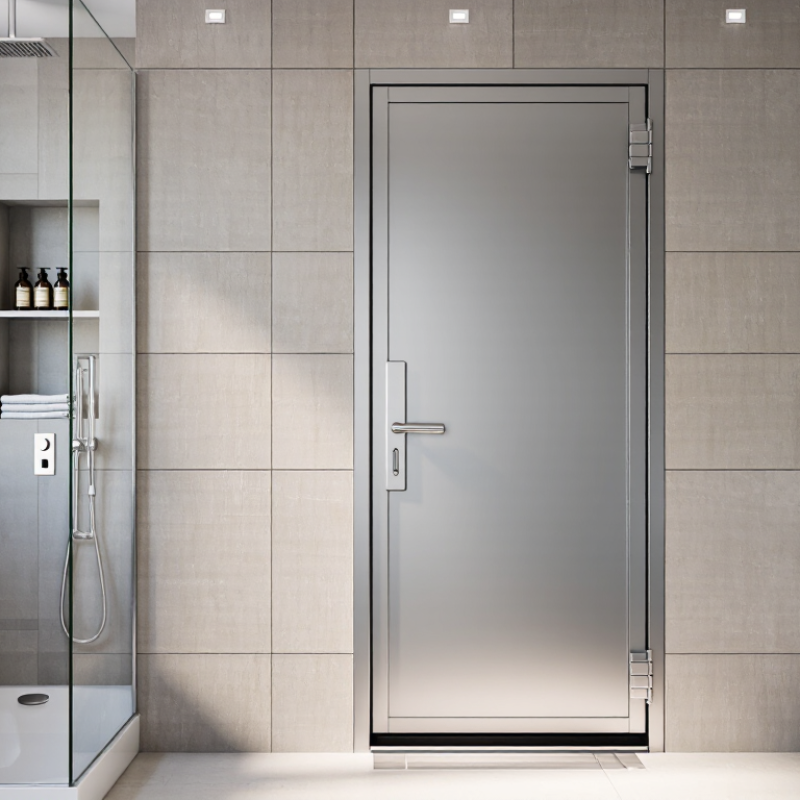
Choosing the right aluminum bathroom door begins with the room’s actual needs, not its appearance. Measure the finished opening after wall tiles, waterproofing, and trim are installed. A practical door width usually falls between 760 and 900 mm. Smaller openings may feel restrictive, especially when carrying laundry or assisting someone inside.
Leave enough clearance for the door movement. A hinged door needs open floor space, wall clearance, and room for a person to stand safely. Check the handle position against nearby fixtures, such as the toilet, basin, or shower screen. A sliding aluminum door can save space, but its track needs a flat, clean surface. Water and grit can affect movement over time.
Measure twice.
I once measured an opening before the final tile layer was fitted. The finished doorway became narrower than expected. That mistake was avoidable. Record the width at the top, middle, and bottom, because walls are not always square. Also check the threshold height and ventilation path. A wide door may still feel uncomfortable if the bathroom layout creates a tight turning area. Local building requirements may specify minimum access widths, swing direction, or safety glass details, so confirm them with a qualified installer. A reliable aluminum door should match the measured space, daily movement, and moisture conditions.
How to Choose the Right Aluminum Bathroom Door?
For bathroom doors, 6063-T5 aluminum offers a practical balance of strength, weight, and corrosion resistance. The Aluminum Association’s Aluminum Standards and Data lists aluminum’s density near 2.70 g/cm³. This keeps the door easier to install than many steel alternatives. Its typical minimum yield strength is about 110 MPa, depending on the applicable extrusion standard and profile size. That figure matters, but it does not tell the whole story. A narrow 2.0 mm profile may feel weaker than a well-designed 1.2 mm profile with deeper geometry. Frame shape matters.
Wall thickness should match door size, hinge load, and daily use. A 1.2 mm wall can suit a compact, low-traffic bathroom with proper internal reinforcement. For wider doors, heavier glass, or frequent commercial use, 1.6–2.0 mm offers better resistance to denting and hinge distortion. The International Aluminium Institute reports aluminum recycling can save roughly 95% of the energy needed for primary production. That supports responsible material selection, although recycled content should be verified through supplier documentation. Numbers need checking.
Tips: Inspect the cut edges and corner joints closely. Ask for alloy and temper certificates. Check whether hinge screws enter reinforced sections. Keep a small clearance from wet floors. A thicker wall is not automatically better; poor drainage and weak hardware can still cause early failure. My practical preference is 1.6 mm for ordinary residential doors, with 2.0 mm reserved for larger or heavily used openings.
Moisture protection should guide your aluminum bathroom door choice. In a busy bathroom, steam settles on the frame, while water collects near the threshold. An anodized coating of at least 10 μm offers a practical protective baseline. It forms a hardened oxide layer on the aluminum surface. This layer helps reduce oxidation, staining, and everyday surface wear.
An anodized coating of at least 10 μm offers a practical protective baseline.
Thickness alone does not guarantee performance. The coating must be evenly applied and properly sealed. Pay close attention to cut edges, corners, hinge areas, and drainage channels. These small details often face moisture first. Ask the supplier for a coating-thickness report and the relevant test method. A clear document is more reliable than a vague promise of “premium protection.”
Inspect the door before installation. The surface should look consistent, without cloudy patches, scratches, or exposed metal. Use neutral cleaning products, because harsh acids and abrasive pads can damage the finish. Keep the lower frame dry when possible. This is easy to overlook. In coastal homes or bathrooms with poor ventilation, a thicker coating may be sensible, depending on local conditions. Still, I would not treat 10 μm as a universal answer. Installation quality, seals, ventilation, and regular cleaning can matter just as much. Even a well-coated door can fail early when water remains trapped around its frame.
How to Choose the Right Aluminum Bathroom Door?
When choosing an aluminum bathroom door, glass safety deserves close attention. Select 6–8 mm tempered safety glass that meets ANSI Z97.1 requirements. This range offers a practical balance between strength, weight, and hardware compatibility. A 6 mm panel may suit a standard shower door with proper support. An 8 mm panel can feel more solid in a wider opening. Thicker is not automatically safer. The frame, hinges, seals, and installation also matter.
Check the glass marking or supplier documentation before ordering. It should identify tempered safety glass and reference ANSI Z97.1. Do not rely only on a sales description. Ask for test information when the project has unusual sizes or heavy hardware. Tempered glass is heat-treated to break into smaller pieces if damaged, but it can still fail after sharp edge impacts. Handle the edges carefully. Small chips around drilled holes deserve attention.
Measure the aluminum frame accurately, including wall variations and floor slope. Bathrooms are rarely perfectly square. That detail is easy to miss. Use compatible gaskets and corrosion-resistant fasteners near constant moisture. A professional installer should confirm hinge capacity, glass clearance, and door swing before fitting. I have found that rushing this check creates more problems than choosing between 6 and 8 mm. Safety glass helps, but good design and careful installation complete the decision.
| Selection Dimension | 6 mm Tempered Glass | 8 mm Tempered Glass | Practical Selection Guidance |
|---|---|---|---|
| Nominal thickness | 6 mm (approximately 0.236 in) | 8 mm (approximately 0.315 in) | Both options are commonly used for framed or semi-framed bathroom doors. Confirm compatibility with the aluminum profile, hinges, rollers, and seals. |
| Approximate glass weight | About 15 kg/m² (3.1 lb/ft²) | About 20 kg/m² (4.1 lb/ft²) | Use 6 mm when reducing door load is important. Use 8 mm only when the complete door hardware system is rated for the additional weight. |
| Safety glazing requirement | Must be fully tempered safety glass for the intended door application. | Must be fully tempered safety glass for the intended door application. | Thickness alone does not establish safety. Request documentation showing compliance with ANSI Z97.1 and verify the permanent safety-glazing marking where applicable. |
| Breakage behavior | Designed to fracture into relatively small, granular pieces instead of large sharp shards when properly tempered. | Same tempered-glass breakage behavior when properly processed. | Tempered glass cannot be cut, drilled, or edge-machined after tempering. Final dimensions and holes must be completed before heat treatment. |
| Rigidity and deflection resistance | Adequate for many framed bathroom doors when the opening size and hardware are properly engineered. | Higher stiffness and better resistance to flexing than 6 mm glass. | Prefer 8 mm for larger panels, wider unsupported spans, or designs requiring a more solid feel, subject to hardware approval. |
| Hardware load | Lower load on hinges, pivots, rollers, and aluminum frames. | Higher load on hinges, pivots, rollers, and frame connections. | Check the complete assembly rating, fastener capacity, wall anchorage, and adjustment range before selecting 8 mm. |
| Impact and edge sensitivity | Tempered glass is stronger than annealed glass, but its edges and corners remain vulnerable to concentrated impact. | Greater thickness provides more robust handling characteristics, but edges and corners still require protection. | Specify polished or properly finished edges, protective setting blocks, suitable gaskets, and hardware that does not contact bare glass. |
| Thermal performance | Single-pane glass offers limited insulation; thickness has only a small effect on bathroom heat retention. | Slightly greater resistance to heat flow than 6 mm glass, but it remains single glazing. | Choose thickness primarily for structural and hardware requirements, not for significant energy savings. |
| Visual appearance | Clean, lightweight appearance with a slimmer panel profile. | More substantial appearance and reduced visual vibration during operation. | Select based on the desired look, frame design, panel size, and the bathroom door’s operating feel. |
| Recommended use profile | Compact, fully framed doors and applications where lower weight and easier installation are priorities. | Larger or semi-framed doors where increased rigidity and a heavier, premium feel are required. | For either option, verify panel dimensions, opening conditions, hardware ratings, and installation tolerances before ordering. |
| Final specification checklist | Tempered safety glass; ANSI Z97.1 compliance documentation; correct thickness; finished edges; pre-formed holes; compatible aluminum frame; corrosion-resistant hardware; compliant seals and setting blocks. | When in doubt, have the door supplier or a qualified glazing professional confirm the complete system rather than selecting glass thickness alone. | |
Note: Glass weights are approximate and calculated from a typical glass density of about 2,500 kg/m³. Actual door weight also includes the aluminum frame, hardware, seals, and accessories.
Bathroom doors face repeated movement, moisture, and occasional force from hurried users. A reliable door should use hardware tested through at least 100,000 opening cycles. This figure represents frequent daily operation over many years. Ask for test records, not only marketing claims. The report should identify the hinges, rollers, latch, handle, door weight, and testing conditions.
Look closely at the test method. Was the door opened smoothly, or was it pulled and released under realistic pressure? A useful evaluation checks alignment, closing speed, latch engagement, and handle looseness during testing. After 100,000 cycles, the hardware should still operate quietly and securely. Minor scratches are acceptable. A sticking latch is not.
Moisture adds another challenge. Inspect fasteners and moving parts for corrosion-resistant materials and protective finishes. Test results from a dry laboratory may not reflect a humid bathroom. That limitation deserves attention. It is easy to overtrust one impressive number. I would also check the door after installation, especially around the lower hinge and latch. Poor alignment can shorten hardware life, even when the original test was excellent. Choose a system supported by clear maintenance instructions and traceable quality records.
It combines moderate strength, low weight, and useful corrosion resistance. Its density is about 2.70 g/cm³, making installation easier than steel.
It can suit a small, lightly used bathroom with proper reinforcement. Wider doors and heavier glass usually need 1.6–2.0 mm walls. Measure twice.
A 1.6 mm wall is a practical choice for many homes. Reserve 2.0 mm for wide openings or frequent daily use.
No. Frame geometry, corner joints, reinforcement, and hinge placement also affect strength. A well-shaped 1.2 mm profile may outperform a poorly designed 2.0 mm profile.
An anodized coating of at least 10 μm offers a useful protective baseline. Coating uniformity and sealing matter, especially around cut edges and corners.
Request a coating-thickness report and its test method. Inspect for cloudy patches, scratches, or exposed metal before installation. Details matter.
Tempered safety glass between 6 and 8 mm usually balances weight, strength, and hardware compatibility. Use 6 mm for standard panels and 8 mm for wider openings.
Confirm the frame measurements, wall variations, floor slope, hinge capacity, glass clearance, and door swing. Bathrooms are rarely perfectly square. Small errors matter.
Keep the lower frame dry and prevent water from collecting near the threshold. Use neutral cleaners, not harsh acids or abrasive pads.
Trapped water can damage the frame even with a strong coating. Weak hardware, poor drainage, and rushed installation also create problems. I sometimes underestimate drainage.
Choosing the right Aluminum Bathroom Door begins with matching the door to your bathroom’s layout and daily use. Measure the opening carefully, allowing for a practical door width of 760–900 mm and enough clearance for comfortable entry, furniture placement, and ventilation. A durable frame should use 6063-T5 aluminum with a wall thickness of approximately 1.2–2.0 mm, providing a balance of strength, stability, and manageable weight.
Moisture resistance is also essential in a humid bathroom environment. An anodized coating of at least 10 μm can help protect the aluminum surface from corrosion and maintain its appearance over time. For safety, select 6–8 mm tempered glass that meets ANSI Z97.1 requirements, as it is designed to provide improved impact resistance. Finally, inspect the hinges, handles, rollers, and other hardware, choosing components tested for at least 100,000 opening cycles to support reliable long-term performance.

Apex Window & Door